

After a hard-partying Margaret and her boy-toy Borachio finish their sweaty cosplaying hookup in Jamie Lloyd’s Much Ado About Nothing, she gives him a little pat on the back. During London previews, the director told actor Mason Alexander Park to cut that bit.
For Broadway, though — before they’d even got to the scene in rehearsal — he asked for it back.
Now, a properly nerdy theater critic can make quite a meal of a pat on the back, and there are two of us on this episode, so naturally we go to town with it. (Adam Feldman: “I don’t want to over-read, but it’s my job.”)
It’s a great visual joke, even as a throwaway, but here it’s also a joke that clarifies an often-murky plot point: Margaret thinks she’s had a perfectly nice booty call. She has no idea she’s just supplied the evidence for a scandal.
Mason says Jamie Lloyd pitched the show as centering on “a weekend bender with your friends”: drunk karaoke, people kissing when they shouldn’t be, everybody having a marvelous time right up until somebody has a truly terrible one.
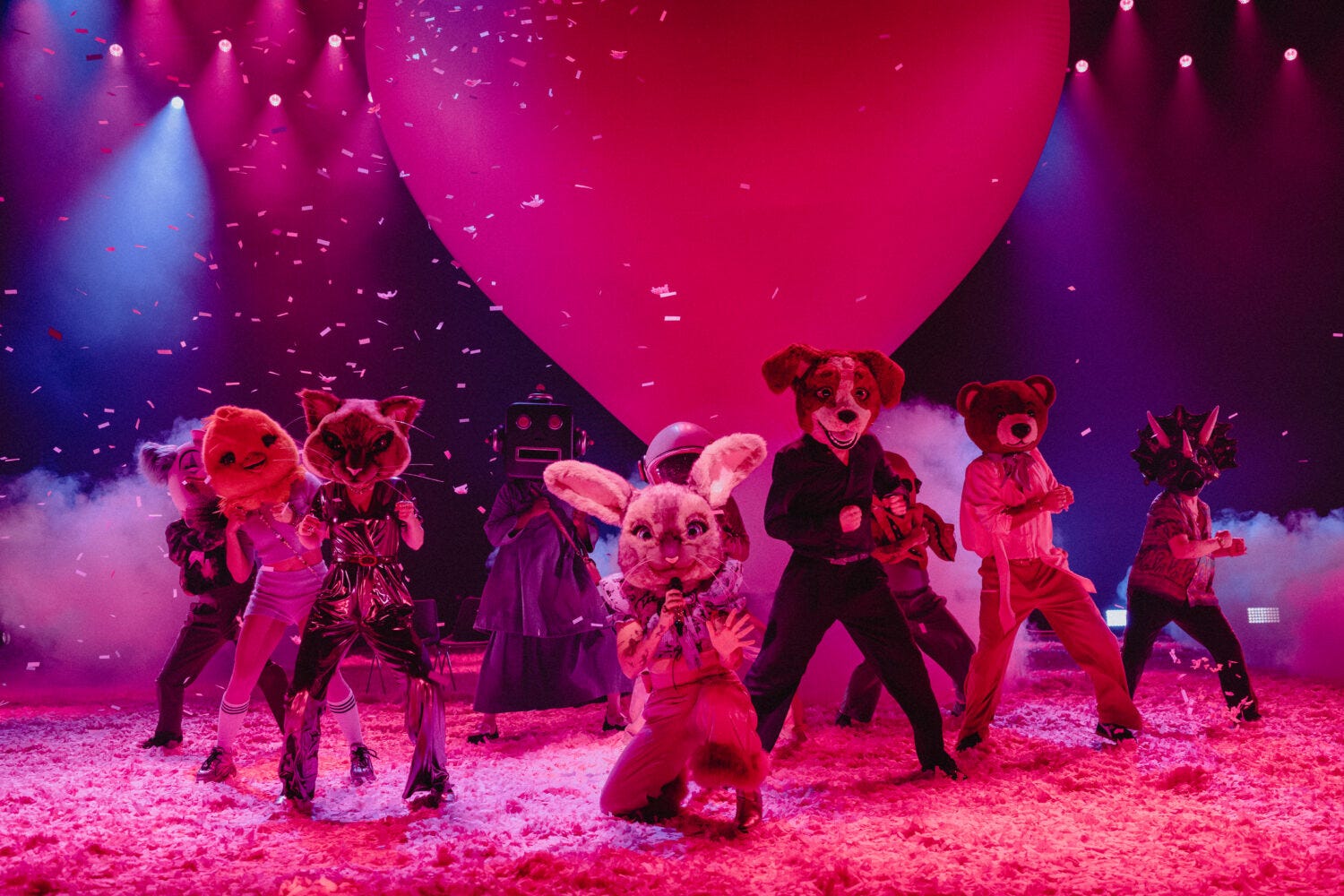
And Park’s Margaret is definitely having a good time at this hot pink rave of a costume party.
She’s borrowed Hero’s enormous yellow chick head, which in the circumstances probably strikes her as a perfectly reasonable thing to be wearing for a bit of randy role-play. It doesn’t occur to her that anybody watching would mistake her for the actual Hero, much less carry the news to the bridegroom.
So the back-pat, delivered after a drunken bang atop a conference-room table,1 gets a laugh precisely because Margaret has no idea what play she’s in.
When the wedding comes along a couple of scenes later, that same ignorance is what makes it awful.
The giant mascot heads are funny, but they also solve a problem that has bedeviled generations of actors in tiny carnival masks: How on earth do you not recognize somebody you had lunch with? Here, between the huge furry animal heads and the booze and party drugs, I’m prepared to believe almost anything.
Including the notion that Don John is somebody these people would invite to a weekend in Ibiza. Here, he’s that one guy — we all know him, and some of us have dated him — who’s included in most of the friend-group shenanigans even though, as Mason says, “We all know he’s a bit sketch.”
Lloyd, notoriously, has cut the Dogberry-and-Verges subplot, but the upside is an a vastly expanded role for Mason, who presides over the party like a bar mitzvah entertainer, wielding a bedazzled holster mic and powering through songs the audience knows well enough to bring its own associations to. Anyone who saw her star turns in Cabaret or Hedwig and the Angry Inch here in the DMV can imagine what a meal she’s2 making of that opportunity. Me, I’d watch Mason host a variety show3 — in or out of character. I suspect the distinction would be largely contractual.
There is a certain amount of bloviating and geekery here, as you might expect when critics collide: Adam actually speaks the word “reified” aloud, which I wasn’t sure anyone did outside academia.
Meanwhile I refer to “the gulling scene” as though it were a household landmark, located maybe between the kitchen and the powder room.
Both of us then forget the names of key supporting characters. Between us, we have like half a century of professional theater criticism experience, but apparently the proper nouns cost extra.
The moment Adam and I wanted to linger over, though, didn’t require much vocabulary. In the early going, there’s that scene where Beatrice and Benedick have been flinging insults merrily at each other — here, from opposite edges of a broad stage that’s been swarming with people. Then they come crashing to a halt, with that marvelous line about “a jade’s trick.” The distance between them hasn’t changed. You’ve just noticed it because of a shift in focus and a bit of actorly craft. What sounded a second ago like two people amusing themselves at each other’s expense suddenly sounds like two people who know exactly where to aim. And it reads like a cinematic close-up — though unlike in Lloyd’s Sunset Boulevard, there’s not a screen to be seen.
Mason tells us Lloyd had the entire cast miked — and mixed, with playback! — from the outset of rehearsals, so actors could discover how small and intimate they could make important moments like that one, and still bring us along with them as they navigate the characters’ quicksilver changes of mood.
I keep coming back to what he asked Mason to put back in. A roomful of people can be looking right at a woman, laughing at a little pat on the back, and not realize until the next morning what they’ve seen.
Attentive purists will point out that in Shakespeare’s text, the hookup happens (and is witnessed from afar) entirely offstage. We hear it planned, teased, and eventually bragged about, but no actual sexytimes are had within the audience’s view. It has become all but traditional in modern productions to add some kind of silent on-the-margins business, though, to help non-Elizabethan theatergoers keep up. On Broadway, as indicated in our onscreen conversation, Borachio (Mika Onyx Johnson) actually cries out Hero’s name, and Margaret doesn’t think twice about it — because she’s wearing Hero’s party costume, and they’re clearly doing a bit of bedroom role-play.
Mason Alexander Park’s Wikipedia entry and earlier press coverage describe the performer as nonbinary and using they/them pronouns. In our conversation, she confirmed what Much Ado’s press agent had mentioned when we spoke: that she’s equally comfortable with female pronouns, maybe even leaning towards them these days. From pre-show audio left on the edit-room floor: “Either/or. … She or they. Maybe it’s just because in my professional life I’ve been playing so many more women. So for simplicity, for people who are tasked with reviewing things … it’s just a lot easier.”
Something of the sort exists already:. Mason and her co-writer Hunter Bird took cues from Judy Garland and Carol Burnett for The Pansy Craze, a six-part live series about the history of queer performance and the recurring bit of cultural arithmetic that’s dogged it: first the mainstream celebrates it, then it commodifies and sells it, then it decides it ought to be against the law. Along the way we meet Jim Bailey, who sang with Liza Minnelli — dressed as her mother, which is something I very much wish I were old enough to have seen live. Adam, for his part, brings up Julian Eltinge, once famous enough to have a Broadway theater named for him. His name has all but vanished from popular memory, but New Yorkers still walk through that old theater’s entrance to go to the movies on 42nd Street.


