

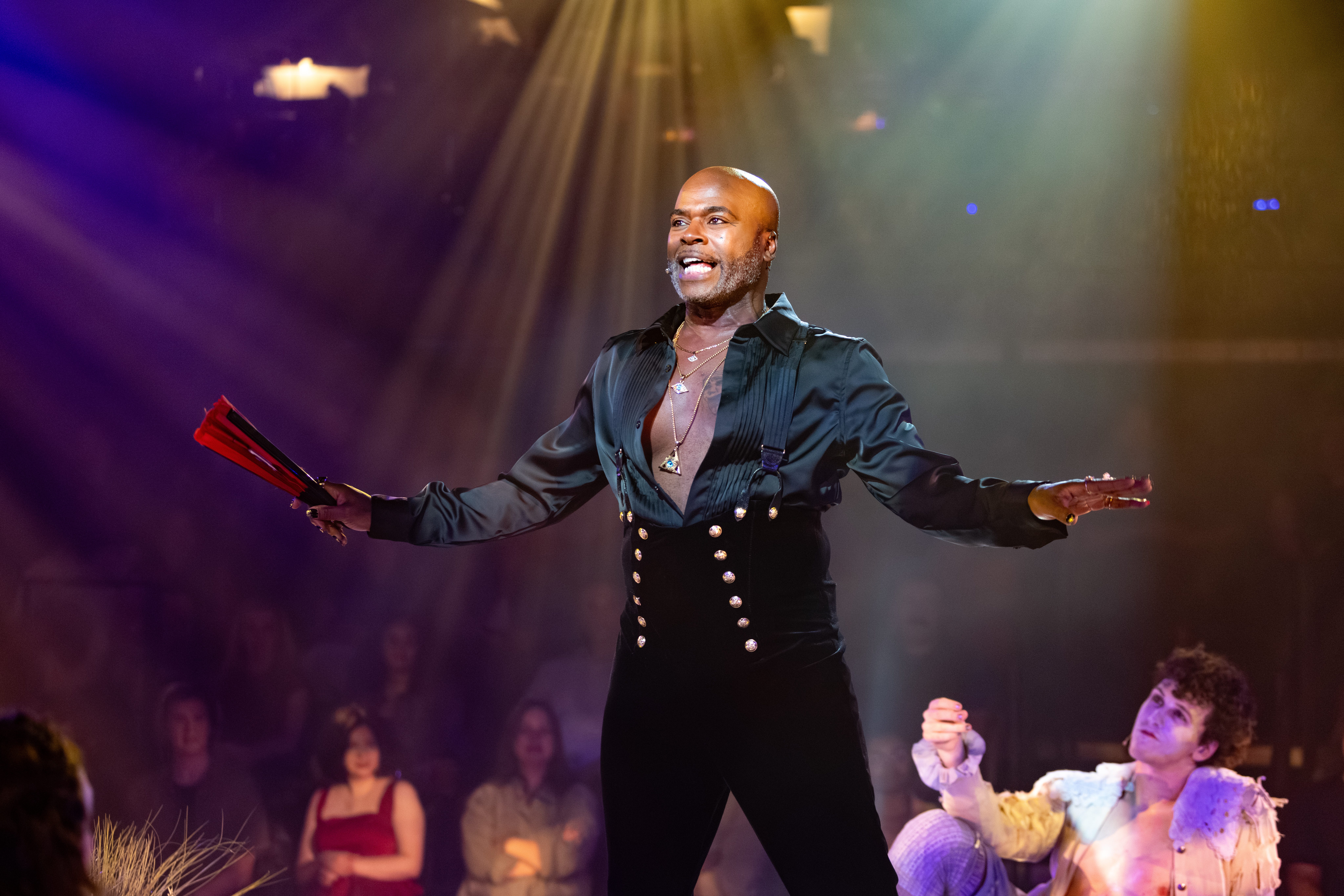
They’ll tell you Pippin is a musical-theater classic, but that’s just because Stephen Schwartz has all the money now, which means everything he’s made must be good — so you have my permission to ignore “them.”
The fact is, Pippin is a dog of a show that’s occasionally been groomed elaborately enough — first by Bob Fosse, who directed and choreographed the original production, later by Diane Paulus, whose 2013 revival reimagined it as a spectacle unfolding as part of a big-top circus — to almost pass as best in breed. Perhaps a third of Matthew Gardiner’s new staging for Signature Theatre rises to that level, which I’ll grant you is enough to make it worthwhile, even if you’re not a particular fan.
Pippin is the sort of thing that happens when, say, an early-’70s impresario notices that Candide is in fact a (messy) classic and Cabaret has recently been a monster hit, and wonders whether a mashup of the two might turn a reasonable profit. The wandering-naif hero of the former meets the mysterious, possibly malignant Emcee of the latter (here called the Leading Player, so as not to invite lawsuits), and the one guides the other through a highly fictionalized version of various events from his life.
Pippin, you see, is inspired by Pepin, one of the real-life sons of the emperor Charlemagne, and he’s quite the character: Brilliant, we’re told, and convinced he’s cut out for extraordinary things. (The odor of unearned privilege is strong with this one. Happily, Brayden Bambino has enough affable-quarterback charm to keep him on the right side of insufferable.)
When he doesn’t find the fulfillment he yearns for within the first few weeks after college graduation, Pippin sets about looking in all the usual places: In battle, in the bedroom, and here and there beyond. Naturally it all dismays or bores him. He really is rather a tiresome git, at least until well into the second act.
The second act is when the chiefest of the Signature production’s undeniable virtues — Awa Sal Secka, a superbly musical singer who’s also becoming a mistress of subtext on par with Nancy Robinette — turns up to teach Our Hero the value of domesticity and personal connection, though naturally he won’t understand it fully at first. Another such virtue is Naomi Jacobson, who in the early going slurps alive the juicy horny-grandma scene that is the sole reason for her character’s existence.
Back to Act Two, though: That’s also when Roger O. Hirson’s shabby book gives up utterly on anything like believable character growth. Perhaps leery of the lessons of Candide, which gets bogged rather gruesomely down in its title character’s endless array of misadventures, Pippin hurtles directly from that I’m-bored-with-domesticity moment to the final crisis that will teach him its value, without anything intervening to further season him. It reeks of dramaturgical desperation to bring the thing in under the 150-minute wire.
Yet somehow I didn’t hate it, not at all. Erik Teague presents the eight members of the ensemble as something between the commedia-style clowns of Fosse’s original and the Cirque du Soleil-style acrobats of Paulus’s reinvention — lots of garters and bustiers, long-nosed masks and distancing Pierrot makeup. Gardiner doesn’t gender-swap his leading player, as Paulus did when she cast Patina Miller in the part that made Ben Vereen a star, but he does set Cedric Neal loose to explore so many possibilities in the realm of crypto-queerness that it makes precious little difference. And as always at Signature, the thing’s credibly sung — sometimes even gorgeously so.
Still, Pippin will never truly be more than what the critic Clive Barnes called it when it first presented its metatheatrical come-ons to a New York audience in 1972: “a trite and uninteresting story with aspirations to a seriousness it never for one moment fulfills … a commonplace set to rock music.”
Oh, right, the music: Schwartz, I’ve decided over the years, is capable of precisely two memorable songs per show, and in this case they are “Magic to Do” and “Corner of the Sky.” Both of them have been done to death by eager theater kids in show choirs and cabarets since they were new, so you’ll doubtless have heard them.
Of course they’re both offered up at the very top of Act One — and I’m afraid it’s mostly downhill from there.
Pippin plays at Signature Theatre in Arlington, Virginia, to July 26.
* This joke is for exactly two people, both of whom are probably Carolingian scholars.
I feel the exact same way about this musical. I directed it last year and found a concept/vessel to hold it in what I believe was convincible brilliance for the time it was up. But I am directing it next year somewhere else, that didn't listen to me saying the piece doesn't hold together.
An apple… or a hobbit.