

This, that, and the other …
I made it to that musical about the assassination of Yitzhak Rabin, and I am here to remind you to resist judging books by their covers. (Look, I’m old and cynical, and the words “105 musicalized minutes about the Middle East conflict in a church basement” might not always inspire breathless anticipation in even the most optimistic consumer of the performing arts. I am quite happy to have been wrong.) I did not, in fact, leave humming the overture, but I did find myself humming the haunting number that frames the story. The chamber-scaled world-premiere staging from Voices Festival Productions wraps up with one final performance this evening, Dec. 7, but as Lisa Traiger’s review for Washington Jewish Week suggested, the show is smart and moving — and yes, ingratiatingly musical — enough to deserve a future. VFP’s current three-play festival continues with Imperfect Allies Dec. 11-Dec. 14 and Apeirogon Jan. 8-Jan 11.
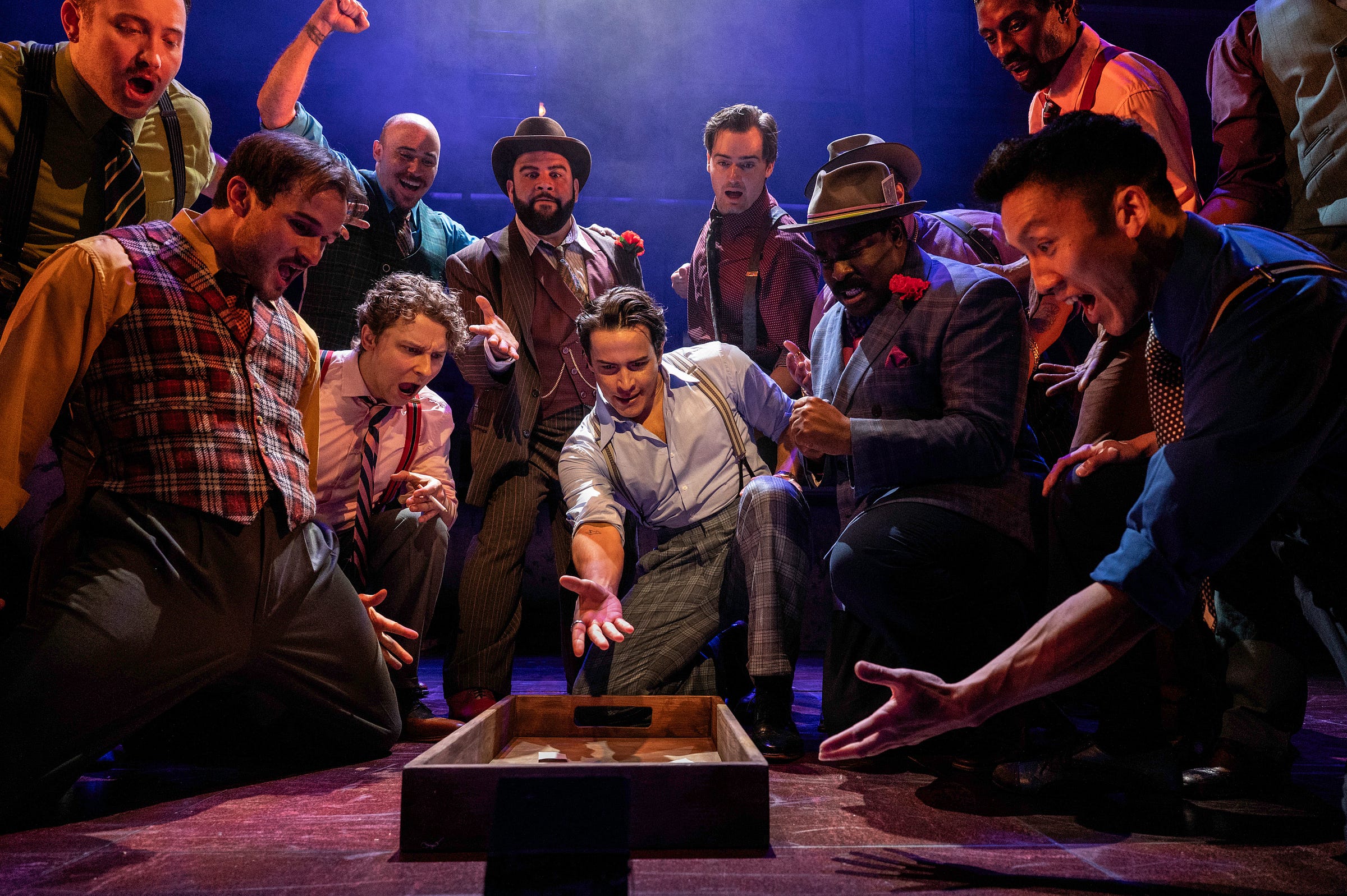
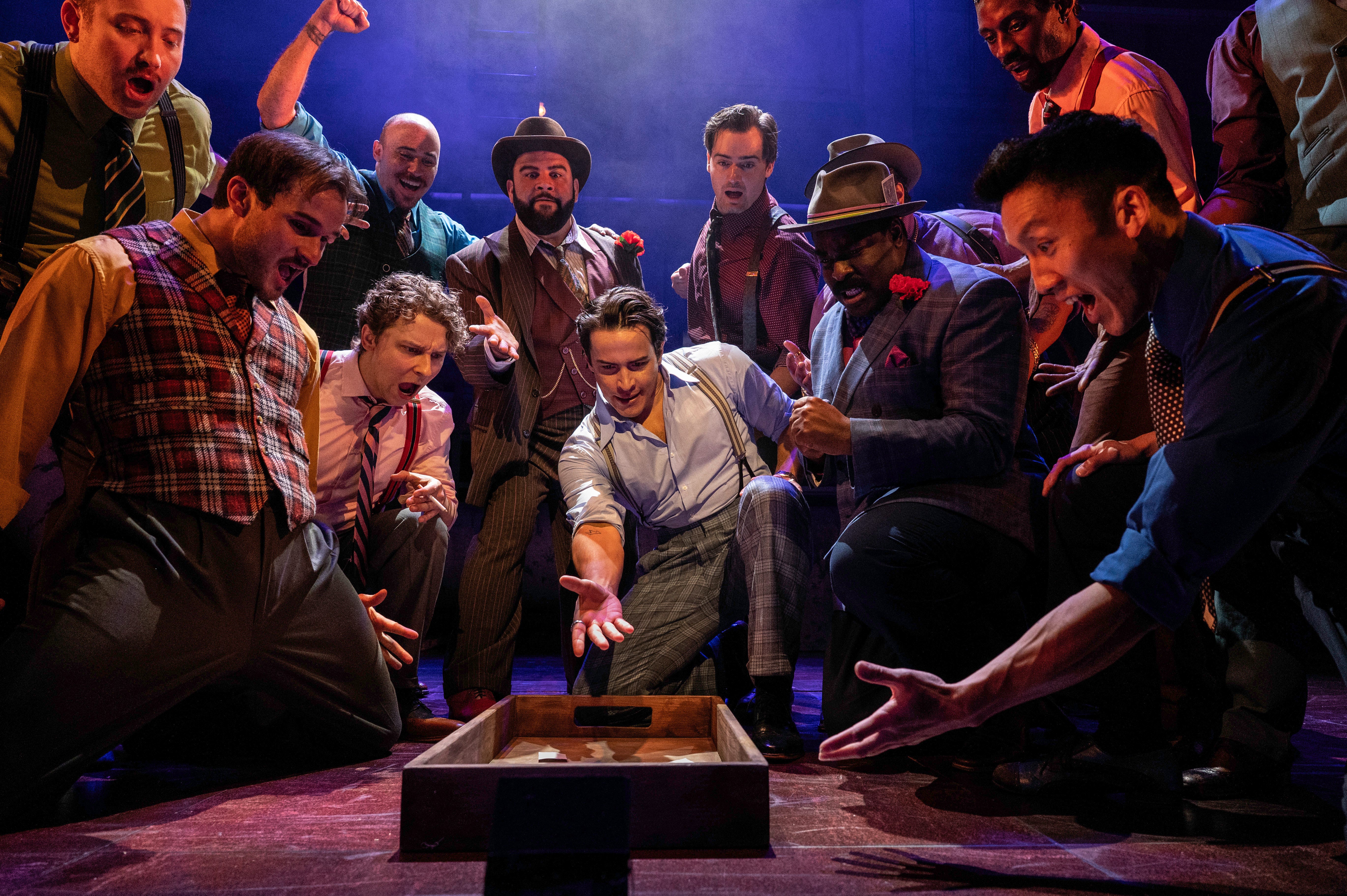
I also made it to Guys and Dolls, y’all, and DANG. Francesca Zambello’s drum-tight production of the classic gambler-meets-missionary romance rolls lucky all night long. Among the more expensive-looking exercises I’ve ever seen from the Shakespeare Theatre Company,1 which has never been afraid to spend a dollar on a big show, it’s already been extended into the New Year. Do not let the holidays make you miss the chance to see Julie Benko and Hayley Podschun (playing Miss Sarah and Miss Adelaide with just absolutely absurd heaps of sparkle and poise and confidence), along with Rob Colletti and Jacob Dickey (as a cuddly-mischievous Nathan Detroit and a seriously swoon-worthy Sky Masterson). Zambello2 draws subtle, expressive performances from her leads; their moment-to-moment beatwork felt remarkably true and human, even from the way-up-close vantage of Row C. Huge applause for the ensemble, what with the sweaty, joyous, sexy workouts Joshua Bergasse (Smash) keeps putting them through; extra-special love for Kyle Taylor Parker, who delivers mightily on the tentpole revival number “Sit Down, You’re Rockin’ the Boat,” and Lawrence Redmond, whose gentle reading of “More I Cannot Wish You” is guaranteed to make you think warmly of the uncles and grandpas you miss the most.
The wait for news about Woolly Mammoth’s next chapter is over: Reggie D. White was named incoming artistic director of D.C.’s near-legendary new-play factory this weekend. The announcement and the takeover will have major implications for the landscape of contemporary American drama. If you think I’m exaggerating, bear in mind that Woolly isn’t just an incubator that’s nurtured playwrights from Nicky Silver to Tracy Letts to Danai Gurira to Anne Washburn, it’s also one of the companies where Rhea Seehorn, star of Pluribus and Better Call Saul, got her start onstage.
Hamnet — Chloé Zhao’s film version of Maggie O’Farrell’s widely celebrated novel imagining the inner lives of Shakespeare’s family — is upon us, already screening locally at the Avalon Theatre, the Alamo Cinema and Drafthouse, and at other cineplexes around the DMV. (Readers elsewhere: It expands to more theaters across the U.S. beginning Dec. 12.) Actor-impresario Austin Tichenor has thoughts for the Folger on how the film shifts focus from Anne (aka Agnes) Hathaway back in the direction of our boy William — and how much that matters. O’Farrell and Zhao join Barbara Bogaev of the Folger’s Shakespeare Unlimited podcast for a conversation about the road to the adaptation. My friends at NPR’s Pop Culture Happy Hour talked about the movie at some length at the beginning of this week. And here’s the trailer, if you haven’t seen it:
Yesterday, December 6, should have been Gaurav Gopalan’s 50th birthday. He’s not with us any longer, because someone — we still don’t know who — murdered him on a D.C. street a few months before his 36th. People who knew him and worked with him across the District’s theater scene recall an insatiable curiosity, a generous collegiality, and a sparkling intellect. And as one of them recalled, in a story I wrote for the Washington City Paper in the wake of his death, “this incredibly beautiful voice.”
From the archive: Where grief and joy collide
Speaking of occasions for grieving: Six years ago today, I hit publish on the essay below, whose subhead at the time was “I’ve been crying a lot lately. I couldn’t be happier about it.” That was partly because my shrink and I had finally gotten my psychopharmaceuticals properly balanced, so I could actually feel things for the first time in quite a while— thanks, Dr. B.. And it was partly because, effective meds or no, three years of the first Trump Administration had left me in something of a state. Not a despairing one, though; quite the opposite. I found myself hyperaware of, and hyper-susceptible to, any hint of beauty, and it took me a while to figure out why. This reflection was the result. Because it all began with a choir and a Christmas carol, I thought I’d offer it up again here as the holiday season gathers steam. — tg
Aswim in the unbearable exquisite
ABOARD THE SILVER METEOR (Dec. 7) — It started with a question about Christmas carols:

I had an opinion, obviously, and then a second opinion, and it was a fun Twitter moment to be part of, but then I got distracted by the fact that I was laugh-crying all of a sudden — and where the hell did that come from?
I mean I know when it came. It came in the descant verse of “Hark, the Herald Angels Sing,” a tune I’ve sung a bajillion times, professionally and otherwise, without losing my shit. Specifically it was in the descanted final verse of the David Willcocks arrangement of the carol, which represents for your average smells-and-bells Anglican what you might call A Tentpole Moment in A Tentpole Hymn of the festive season.
(It’s not The Tentpole Hymn of Christmastide, mind you — that’s “O Come All Ye Faithful,” which has an even better Willcocks descant — and of course Christmastide is not The Tentpole Season, because duh that’s Easter, which (a) is the whole point of Christianity and (b) is also when we get to bust out Hyfrydol, which is stately and badass, and which presents many an amusing opportunity with its multiple iterations of “A-ha-ha-ha-ha-lay-LOOOOOO-ee-yah.”)
(Their little treble pipings! I die!)
An aside: I know that Anglicans, pale male Anglicans especially, aren’t meant to have actual feelings about anything, certainly not anything to do with religion, but the fact is that secretly we kinda groove on our church-music tradition, whose sophistication is A Thing We Can Be A Touch Snotty About. It’s a reserved kind of grooving, this enthusiasm for our Willcockses and our Wesleys and our Charles Villiers Stanfords — honest to God, his name was Charles Villiers Stanford, and yes we do stan-for(d) him. Stiffly, with our jaws in regulation Cantabrigian clench, but still it is undeniably stanning.
When our pleasure in these things does make itself actually manifest, though, it typically surfaces as a kind of beaming, clubby “Good show!” sort of thing. I mean, I’ve definitely been part of some high-holy services (hi there, Church of the Good Shepherd) where choir and congregation alike got a bit flushed as we roared our collective way through a favorite hymn setting.
(It is just a tiny bit possible that at one or more of these services, my friend Skip and I played the fool and joined the sopranos on some of those Willcocks descants. Maybe. Perhaps. Because THEY’RE FUN TO SING SO SUE ME).
(Also our Holtkamp pipe organ had a zimbelstern mounted high up, front and center, and if you’ve never sung a boisterous Christmas hymn under what’s basically a spinning hood ornament that’s making glockenspiel noises while the organist lays down a boss pedal trill, you Have Not Lived.)
So anyway last week — last week, with the blubbering, was different. I was alone, for one thing. At home, after a bit of a day. It was the end of Thanksgiving week, so there had been all those goings-on out at the farm with my folks, and then the trip up to D.C. and an on-air shift at WETA. And a day up to my ears in music is a day with some live nerve endings, to be sure, so I was probably a little thin, emotional defense-wise, when Prof. Mosley tweeted out that question, which steered me eventually to a video of “Hark, the Herald” as delivered by the Winchester Quiristers, who sing it ravishingly and with the oh-is-it-Tuesday-again aplomb only a boys’ choir with 600 freaking years of English public-school tradition behind it can muster.
ANYWAY I’m singing along with the Quiristers, natch, as I’m loading the washing machine, and we get to “Born to raise the sons of earth,” and I can’t sing anymore because my breath is gone and my throat has closed and my chest is tight and my eyes are burning. And I laugh at myself, which is when the dam breaks for real, and there are the actual sobs — gasping, wide-eyed, guttural.
Which: What the hell, man? It’s a Christmas carol.
Thing is, this has been happening here and there. When Jessye Norman died at the end of September, I listened to a bunch of her stuff, and it was no surprise that there were some tears. She was important in my baby-ghey world, a diva at the peak of her fame when I was coming out, a singular, larger-than-life personality who’d somehow emerged from my hothouse of a hometown and gone on to conquer the world. Listening to her recording of Mahler’s “Ich bin der Welt abhanden gekommen” — about escaping the world’s tumult, about dwelling peacefully in solitude and in song — on the day we got news of her passing, just as I was starting a new and quieter chapter in my own life … well, you know.
But it’s not been just the sad stuff, or the milestone stuff. I got teary the other day talking to a friend about the softness of Rembrandt’s eyes in the self-portrait I love so much at the National Gallery in Washington. I felt a lump in my throat a few weeks back watching actors pretending to land on a version of the moon that doesn’t exist — a moon the Soviet Union reached first, a moon to which women journeyed alongside men and where ice deposits promise them longer journeys outward — on For All Mankind, the new alt-history space opera from Ronald D. Moore, the ST: DS9 nerd-hero who also rebooted Battlestar Galactica so intelligently a while back. Hell, I choked up watching David and Patrick navigate a relationship hiccup on Schitt’s Creek earlier this year, not because it was a big deal but because they were so tender about it.
It’s something about that, I think. The presence of anything these days that bespeaks kindness, gentleness, mildness, grace. And hope? Forget about it. Show me hope, show me optimism, remind me that we are capable not just of good but of greatness, and I’m done.
Not just done — undone.
I was listening to Mahler’s Second Symphony a week or two ago, on one of my drives from D.C. down to the South Carolina coast, down to where Nikki Haley says there are no hateful people and where the flags are about service and honor and tradition, down to where earlier this year a white man was convicted of enslaving a developmentally disabled black kitchen worker — basically caging him up in the back of the restaurant and beating him when he made a mistake or when he just, you know, looked at somebody wrong.
And as Leonard Slatkin’s St. Louis Symphony and the massed choirs thundered into the wild and elated faith-claim of the final chorale — Aufersteh’n, ja aufersteh’n wirst du, Mein Staub, nach kurzer Ruh! goes the shout of 100 choristers and more: “You will rise again, my ashes, my dust, in an instant, and he who has called you will make you immortal!” — I found myself driving blind. I had to pull over and sit on the side of the highway, shoulders heaving, body clenching and unclenching and clenching again with sobs.
I am not religious, mind you. I’m barely what the twee folk call “spiritual.” This was something else, something to do with that hunger for reassurance in an ugly time, but also something to do with a renewed sense of wonder, and of gratitude, at what towering things we humans are capable of when we are our better selves. If my new, slower life has left more room for grief at how awful we can be, it’s also left so much more room for that wonder and gratitude. And I keep getting blindsided by it.
I mean, the audacity of the poet’s cry in that text. The titanic wash of sound that is a Mahler orchestra rounding third base, with nothing and no one between it and home. The utterly leveling overload of those final passages — the choir hurling its exaltation into the hall and then falling spent and dumbstruck while first the warm low horns and then the higher, brighter brass repeat the call up to the heavens, faltering, fading, and then — oh god, oh god — rallying for one last ecstatic sunburst over an earthquake in the tympani and a tsunami of jubilation from the concert-hall pipe organ — there are just no words for it, even were I better at this than I am. You have to hear it, and if possible see it:
The bells! I always forget about the bells until the percussionist gets out his hammer. And three gongs, each brawnier than the last!
It is just too much joyful in one place and moment. It is an explosive, agonizing kind of happiness merely to know that this astounding thing … exists. This luminous thing, and all things that are good on this order of goodness.
There’s this term, to anneal, from metallurgy, that’s long since drifted into metaphor, where it means to subject something to the sort of cleansing and tempering that’s possible only in a fire that burns away the weak, the bad, the brittle.
I am just so crushingly happy that these good things exist, these scouringly pure and beautiful things, these distillations of the unbearable exquisite. For me, for us, for everyone, for always.
Not just to watch or listen to, but to partake of, to surrender to, to spread our arms wide before — to be awash in, to be annealed by, just now, when we need strengthening so very much.
And finally …
The kittens, who are now six months old, discover something new and exciting every week. This week, the new and exciting discovery has been … loose pennies.

Do you have any idea how much noise a kitten can make with a loose penny on a hardwood floor? And for how long? And at how many different inconvenient hours of the day?
As you gird yourself for the escalating insanity of the holidays, I wish you all the wonder and energy of a six-month-old kitten. Please do not shed on the carpet.
Next time,
— trey
Yes, I am aware I’ve been bullish on the company this past couple of years, filing reviews of Leopoldstadt and Frankenstein that ranged from respectful to relatively boosterish. Lest you think I’ve become a reflexive cheerleader, I will mention that the experience of seeing The Wild Duck — which I was not asked to review, and about which I never wanted to think again afterward — made me want to throttle the next idealist I encountered.
Widely acknowledged nowadays as a top-rank international director, the Washington National Opera’s artistic chief made her Metropolitan Opera debut 33 years ago with a postmodernist staging of Lucia di Lammermoor that drove New York audiences absolutely out of their minds — and having seen it, I should clarify that I do not mean that in the good way. The initial NYT review recalls “an exploded castle, its marble walls fallen and twisted, resembl[ing] the disordered mind of a neurotic, [the stage] strewn with empty sarcophagi, shattered statuary and a mountain of coffins.“ I seem to recall the chorus being either offstage or in the pit, with members of the corps de ballet standing in as soldiers and locals and minor courtiers, roaming the halls of Lammermoor wielding what appeared to be long bamboo poles that had for some reason been dyed red. Alas, I cannot find a streaming video record of the production. The headline soprano was June Anderson at the premiere, but unless I misremember I saw it about a year later with Mariella Devia, whom I remember as being entirely astonishing, although a second Times critic decreed that she took some time to find her feet, and that the production’s “pretensions and wrongheadedness, I am afraid, survive intact.” It would probably be a roaring success today, but 1992 Manhattan was not ready.